Fashion, at its best, has always been a form of cultural intelligence: a reading of the moment, expressed through what people choose to put on their bodies. A conversation with Samantha Mureau, founder of Planet of the Grapes.
Samantha Mureau understood this when she entered the industry in the late nineties, buying for Topshop during years when the work still ran on instinct and creative nerve, forecasting for Victoria’s Secret and Limited Brands when that still meant something beyond margin optimisation.
She loved the industry for what it was capable of being. Then she watched it become something else.
The shift was gradual, then total.
After 2008, design gave way to price point.
Every store looked like the next.
The creative restlessness she had built a career inside drained away, gradually and then irreversibly. And when the documentary True Cost came out—showing both the social and environmental cost of what we as a society had built—and Topshop, one of the brands featured in the film, appeared in a scene, Samantha knew she could not go back.
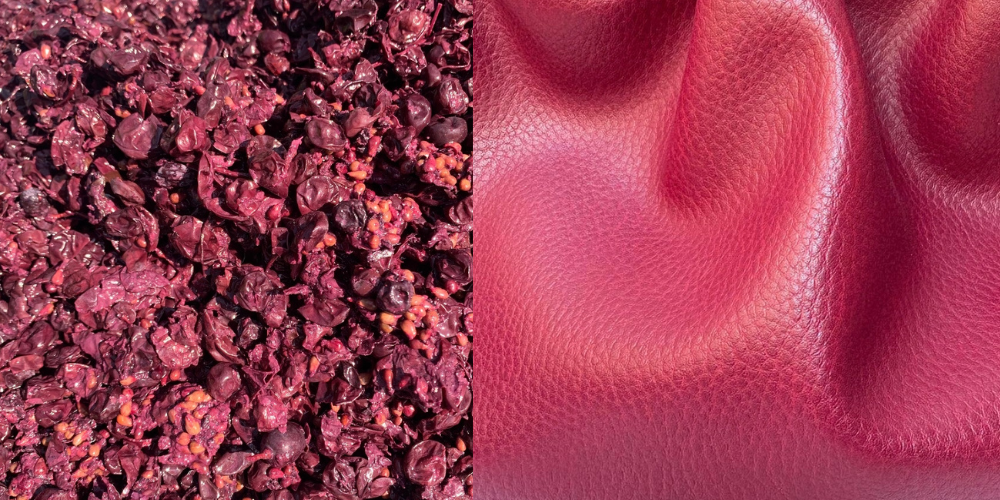
She began researching, and the work led her, with the particular logic of someone following a conviction they cannot entirely explain, into the organic vineyards surrounding her home. From the pomace, the skins, the fibres left at the edge of each harvest after the wine had been made, she developed what would become Planet of the Grapes. Circular biomaterials born from agricultural waste, carrying the provenance of the land they came from. Surfaces that hold terroir the way a fine wine does, visible in the fibre, legible in the texture, entirely honest about their origin. What the wine industry discards, Samantha has reframed as a beginning. Regeneration, in her hands, is both ecological and symbolic: the life of a harvest extended beyond wine, beyond consumption, into something that endures.
We spoke with her about the slow unravelling of fast fashion, what is changing in luxury, and why origin has become the defining question in materials.
You spent over twenty-five years working inside the fashion industry, from a number of different angles, as you put it. When did continuing as usual no longer feel possible?
I’ve been in and out of the industry for over twenty-five years, and my relationship with it has always depended on what it was giving me and what it was asking of me. The late 90’s and the early 2000s were a genuinely fabulous creative time. Buying for Topshop, forecasting for Express and Victoria's Secret, it was about gut feeling, experimentation, expressive design. I loved it completely.
Then the financial crisis hit in 2008, and everything that followed felt like aftermath. Design gave way to price point. Stores became interchangeable. The copying became systematic, and the creative instinct that had once made the industry feel alive slowly drained out of it. That is when I started falling out of love with fashion.
I had also made a life change by then, two young boys, a French husband, a move back to Aix-en-Provence where I had first studied and where we had met. I was looking for something with a different quality of focus. When Rana Plaza happened, it terrified me that people, women essentially, were dying whilst making our clothes. And when the documentary True Cost came out, showing both the social and environmental cost of what we had built, and Topshop, one of the brands implicated, appeared in a scene, that was it. I knew I couldn't go back. The fashion industry I went into was not what it was—and somehow, we have slipped further since.
“The fashion industry I went into was not what it was in 2015. And somehow, we have slipped further since.”
That was the moment I decided enough was enough. I discovered the field of fashion and sustainability, set up my own university programmes teaching an alternative way of working the industry for the next generation. And with that research, I rolled up my sleeves and got to work on agricultural waste from the local organic vineyards around me. That's when Planet of the Grapes was born.
Planet of the Grapes transforms vineyard waste into circular biomaterials. How do you think the industry—and consumer culture—have evolved since to make this kind of innovation visible, and wanted?
Funnily enough, the fashion industry twenty-odd years ago was already way ahead of the curve in its own way. It was about gut feeling, about experimenting, about being expressive through styles, designs, materials. That energy still exists in a handful of brands right now. But what is genuinely promising is what is happening at the edges: the new brands setting up are doing business in a sincerely more socially and environmentally respectful way, and they are looking seriously at the new biomaterials. This direction matters enormously.
What has also changed, first imperceptibly and then with real momentum, is how materials themselves are being read. What was once overlooked, soil health, seasonal rhythms, the specific identity of a place, the terroir of a landscape, has become legible, even desirable. Materials now carry provenance in the way fine wines or heritage textiles always have, and for designers this opens entirely new creative territory where surfaces are singular, colours are drawn from the land, and textures reflect origin. Regenerative agriculture has entered luxury through craftsmanship, storytelling, and aesthetics. And the end customers are seeing more of what has been hidden for so long. Increasingly, they are looking for innovation and new materials, and they can drive change, both as customers and as the generation entering the industry.
“What was once overlooked, soil health, seasonal rhythms, the specific identity of a place, the terroir of a landscape, has become legible, even desirable.
The uptake is slow. But it is starting to happen, and you can feel it.
Stella McCartney, Adidas, Gucci Off The Grid: premium brands are visibly exploring regenerative and bio-based materials. How does this raise the bar for what the wider industry is expected to deliver?
It is great that these movements are happening. In particular with Stella McCartney, who has always stood apart and stood out. She is respected for working with new materials and bringing innovation to the forefront, and that is genuinely exciting. That credibility matters enormously in a field that is still fragile and still easily dismissed. The Kering Group is also starting to work on their own material innovations now, and I am curious to see where that goes.
What these movements signal, collectively, is something more significant than a premium trend. Luxury is undergoing a recalibration, one in which intimacy with a material's origin has become a form of real value in itself, and proximity to nature has become the new marker of refinement. Regenerative materials introduce a new quiet confidence into that conversation. These materials do not imitate what existed before them, and that is precisely their strength. Their value lies in honesty: the visible fibre, the subtle irregularity, the tactile sense of something still alive. Creativity expands when materials are cultivated, and luxury evolves when it chooses continuity, materials that, like vines, improve the system simply by being part of it.
There is certainly a great deal of innovating happening right now, and new and exciting materials are coming through. The next challenge, the one the whole field is going to have to answer, is whether any of this can scale to the point of systemic impact. That is where the field must go next.
Bringing these materials from vision into production is where the real work begins. From your experience, what are the biggest obstacles brands face when integrating regenerative materials into real manufacturing?
It really depends, because each material has its own characteristics, its own behaviour, its own requirements, its own relationship to how it is worked. That is perhaps the most honest answer I can give, and maybe it is also the answer: they are all different. They all need to be treated and worked with differently. That diversity is the beauty of them. For fast-moving fashion businesses built around speed, it does not always fit the existing model.
“It needs to be worked with a new mindset. Meet it on its own terms.”
Our grape-based biomaterial is scaling, and it can be used in conventional manufacturing facilities, on standard sewing machines, edge-painted and branded. But we do need to work closely with the factory initially, because it is a new material and it needs to be worked with a new mindset, not as a comparison against other materials that may have been around for decades or centuries.
Looking ahead three to five years, what does success look like for you, and for Planet of the Grapes?
Success for me personally, and for Planet of the Grapes, would be that we work and co-create with like-minded designers, brands, and businesses in the fashion and lifestyle industries, those with genuinely shared values. And that means thinking and working beyond the materials themselves, acknowledging the holistic approach we are creating. It means considering each stage of the supply chain, and every person working within it. We are all human, no matter at what end of the supply chain we are. We need to bring back balance. The industry has been weighted entirely too far toward brands for far too long. That goes for our resources too.
On that basis, I also hope that end consumers are asking for new biomaterials as sincerely as the industry is offering them, and that we are never used as a simple ESG exercise. Sincerity is something you can feel. The difference between a genuine commitment and a marketing instrument is not always visible on the surface, but it is always felt eventually.
“It is not wishful thinking, if we are genuinely doing the work.”
If we can grow in that momentum, if we can collectively clean up the fashion and lifestyle industries, even in a small part, that is success to me in three and five years’ time. It is not wishful thinking if we are genuinely doing the work. We need to do it, not just talk about it. Are you ready to join us?
Planet of the Grapes is based in Provence, France. Samantha Mureau’s grape-based biomaterials are currently in development with select design and lifestyle partners. More at www.planetofthegrapes.fr