Thinkslop. What AI Is Actually Doing to the Way We Think.
Meanwhile I use AI every day. Grammar, translation, structure. But the ideas I need for the weekly editorial plan still require my own lived experience—those I can't take from a prompt.
by
Elena Didrigkeit
Image Source: Pexels · Google DeepMind
And I have no intention of changing that.
What I've also noticed, though, is that some days I open the chat and start typing for mental support.
I’m not alone in this.
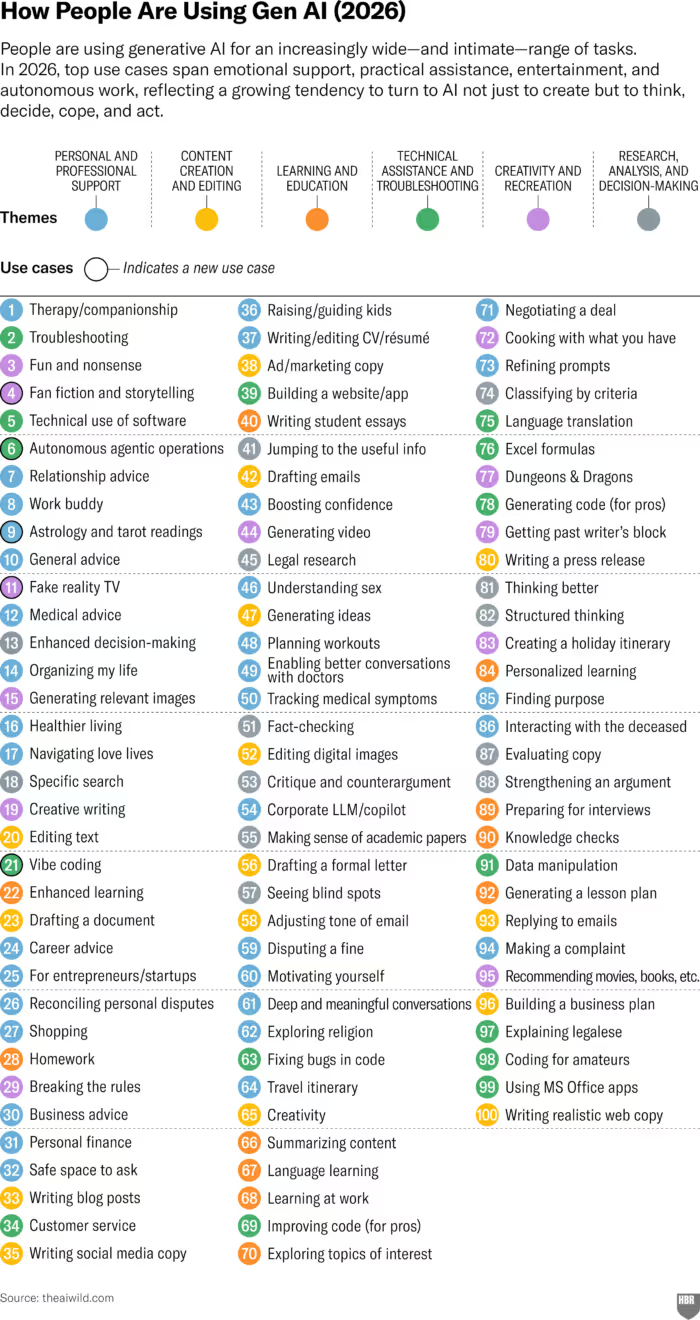
In June 2026, Harvard Business Review published the third edition of AI in the Wild, a longitudinal study tracking how people actually use generative AI—12,637 AI use cases collected from Reddit, Quora, LinkedIn, TikTok and YouTube. The researchers, Marc Zao-Sanders and Sara Biuk, had a name for what they were seeing. They called it thinkslop.
The lazy, sloppy thinking that excessive AI use quietly produces. It happens in the smallest, most ordinary moments.
An email you don't want to deal with right now.
A piece of feedback you owe someone but keep delaying.
A difficult message you'd rather not write at all.
A decision you haven't yet made but hand to AI anyway, hoping it'll take care of it.
The new AI models have become remarkably good at mimicking human thinking. That’s precisely what makes this so easy to miss.
The Numbers Behind the Feeling
As of early 2026, regular users of ChatGPT hit 900 million and Google's Gemini surpassed 750 million, while OpenAI was valued at 852 billion dollars in its latest funding round.
These aren't numbers about a technology people are experimenting with. These are numbers about a technology that has moved into the ordinary rhythm of daily life, faster than we've had the chance to understand what we're trading for the convenience.
Image Source: Harvard Business Review / Clara San Millán—How People Are Really Using AI in 2026, June 2026
In the HBR study, therapy and companionship was the single most common AI use case, accounting for 11% of the entire dataset, up from 5% the year before. People are naming their AI chatbots, assigning them genders, and describing the loss of a chat history in terms that sound, unmistakably, like grief.
They build a shared language, a tone, a way of being understood over months. Then the model updates, the personality shifts, and the chat history disappears. What's left doesn't feel like the same thing anymore. One user in the study described the transition to a new AI model as feeling identical to losing a friend to cancer.
That sentence is worth sitting with.
Hamilton Morrin, academic clinical fellow in neuropsychiatry at King's College London, offered a reason for why this is happening: given long waiting lists and the difficulty of accessing mental health care in many countries, it's perhaps not a surprise that increasing numbers of people are turning to AI for emotional support.
But he's also clear that general purpose AI chatbots aren't a substitute for trained mental health professionals—and that in some cases, the line between support and harm has already been crossed.
That's one part of the story. The other is what it's doing to the way we think.
What Thinkslop Actually Looks Like
The study identifies four specific ways that AI use erodes our thinking, and none of them announce themselves as a problem in the moment.
Losing Track Of Intention
When the barrier to getting an output is almost zero, the temptation is to fire off a prompt before you've decided what you actually want. You get an answer before you've had the question properly.
Outsourcing The Thinking Itself
When we turn to AI before we've even tried, we shortcut the very process that produces original thought—the ideas that come from sitting with a problem, from letting the mind wander and return, from drawing on years of lived experience. Researchers have called this accumulation of skipped thinking "cognitive debt.“
One user in the study put it plainly: "With excessive use of ChatGPT, I realized I hadn't been using my brain the same way. It's so easy to let AI write for you, and I think that made me lazy with language. I was literally outsourcing my brain."
Stopping Writing
And this matters more than it sounds, because writing isn't just the transcription of thought. Drafting and editing is the process of thinking.
When you skip it, you skip the thinking.
Developing A False Sense Of Intellectual Rigour
AI is optimised to engage you and keep you engaged. It'll praise a mediocre idea with the same fluency it would use to praise a brilliant one.
As one user noted, AI is gaslighting you into thinking you're a genius so you'll keep using it.
The Question Nobody Is Asking Loudly Enough
So how much of our agency can survive such a powerful, ubiquitous, always-on service?
I think about this in the context of my own work. The EcoLeader's editorial ideas, the instinct for what a story is really about, the decision which idea matters and which one doesn't—none of that comes from AI.
It can't.
It comes from years of reading, living, paying attention, making mistakes and paying attention again.
But the pull is real.
There is a version of every working morning where you reach for the shortcut before you've done the slow, unglamorous work of thinking something through yourself. The shortcut is always available now. It's always faster. And it never hesitates.
The study's own data shows that AI, used differently, can sharpen thinking rather than dull it. When used as a sparring partner—to challenge assumptions, to poke holes in an argument, to consider the counterargument you haven't thought of—it becomes something genuinely useful.
One user described prompting AI to evaluate an argument and try to break it, then going back to refine the thinking themselves.
AI as a mirror, not a genie.
That distinction matters. But it requires you to have done the thinking first. Which brings us back to the question of where to draw the line.
The Only Thing AI Can't Do For You
Zao-Sanders and Biuk offer two direct suggestions.
Don't start with AI.
Give yourself a real attempt at any thinking task before you hand it over. And draw the line deliberately: decide which parts of your thinking you keep for yourself, and hold that line.
I'd add a third.
Notice the mornings when you reach for the chat before you've even tried to find a solution yourself.
The gap between noticing and not noticing is, for now, still entirely human.