It gave us a framework at a moment when we urgently needed one. Yet today the term feels strangely hollow, as if its meaning has dissipated under the weight of its own complexity. We speak it, but we no longer feel it. It has become a corporate language, an architecture of metrics, methodologies and consultancy products that orbit far above the lives of ordinary people.
Most people care deeply about the world they inhabit, yet they are no longer sure what sustainability requires of them. The term has grown dense and technocratic. It warns, corrects, restricts and optimises, but it no longer inspires. And so the question arises, almost reluctantly: what if sustainability is no longer the horizon we should be moving toward?
A different conversation is unfolding, one that feels both ancient and new. It does not need charts and reports, only the fundamental intelligence of living systems - the intelligence we now recognize as regeneration.
The Limitations of Sustainability
Sustainability, in its modern form, grew out of an era dominated by resource management and damage control. Its promise was to reduce harm, to stabilise decline, to hold the line against the accelerating consequences of industrial civilization. It taught us to recycle, reduce and conserve. It invited us to calculate our carbon offsets, footprints and rein in our consumption. These efforts mattered, and they still do, yet sustainability remained, at its core, a philosophy of minimisation.
To sustain means to maintain. The notion carries the weight of endurance rather than possibility, encouraging the preservation of a weakening system instead of the daring act of imagining what could grow in its stead.
The limitations of this framework became unmistakable when the world rallied around Net Zero commitments. In December 2020, climate scientist Dr. Joeri Rogelj of Imperial College London cautioned that many Net Zero pledges risked becoming elaborate exercises in creative accounting. His concern was not cynical. He simply noted that a growing number of commitments relied on theoretical future technologies, distant offsets or unrealistic timelines, allowing governments and corporations to claim progress while postponing the most meaningful actions. What began as a scientific benchmark for planetary balance slowly transformed into a political incantation, polished enough to reassure but insufficiently grounded to deliver meaningful change.
Rogelj’s warning exposed a structural flaw in the sustainability narrative. Sustainability had reached a point where its complexity outpaced its clarity. It had become too abstract, too professionalized, too exclusive, and too distant from the very people who needed to participate in change.
The Regenerative Turn
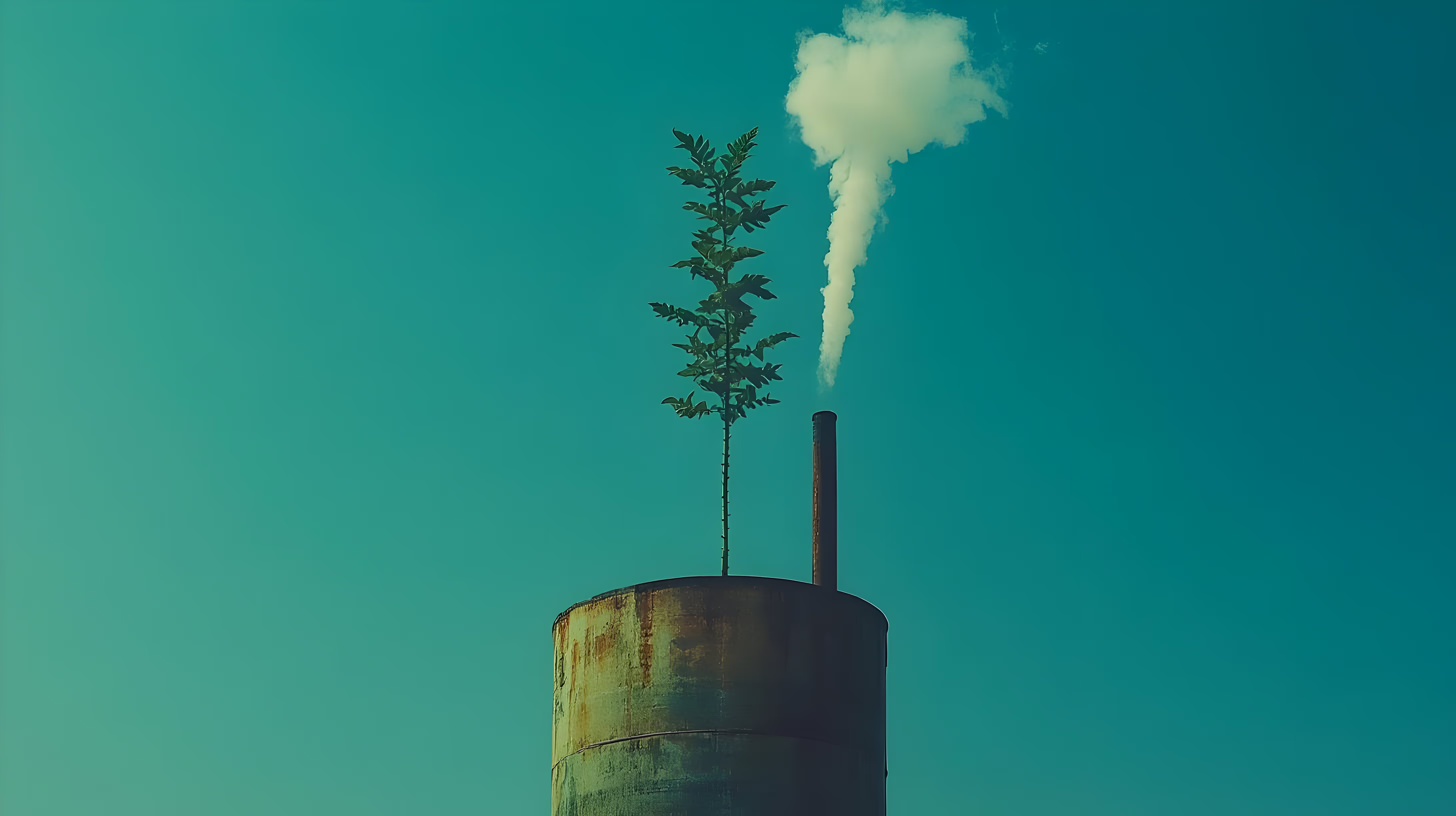
Regeneration enters the conversation precisely at the point where sustainability reveals its limits. Rather than functioning as a strategy, regeneration operates as a worldview, one grounded in the recognition that life never merely maintains itself but instead moves through continuous cycles of renewal. Forests regenerate after fire, soil regenerates after disturbance, communities regenerate after disruption, and even the human spirit regenerates when offered care, connection and purpose.
Paul Hawken, in his influential book Regeneration, describes this phenomenon as a universal impulse embedded within all living systems. Regeneration does not behave like a movement seeking to impose a single manifesto. Instead, it reflects the innate tendency of life to heal, adapt and grow more resilient. When human societies begin to align their choices with this impulse, transformation ceases to feel burdensome and becomes a natural extension of how life itself operates.
This paradigm stands in stark contrast to sustainability, which often urges restraint and reduction. Regeneration shifts participation toward the creation of vitality rather than the avoidance of harm. It is inherently inclusive because it begins with the simple, generative belief that every person, regardless of scale or circumstance, can contribute to the flourishing of life.
A regenerative worldview understands that healing ecosystems cannot be disentangled from healing communities, economies, relationships and the ways in which we navigate our daily lives. This approach does not require deprivation or asceticism. In truth, it reframes luxury as a richer, more intimate relationship with the living world, a form of elegance grounded in reciprocity and depth rather than accumulation.
The Failure of the Old Paradigm
Perhaps the clearest sign that the sustainability paradigm has weakened lies in the emotional distance people now feel toward it. Sustainability seldom stirs a sense of vitality or aliveness, nor does the concept speak to desire, imagination or belonging. The framework has evolved into something designed primarily for institutions rather than individuals, an intricate architecture of compliance that leaves little room for genuine participation or inspiration.
Regeneration moves in the opposite direction. Life expands under its influence; horizons widen rather than contract. Individuals become active agents rather than reluctant reducers, and engagement with the world shifts from careful rationing to thoughtful cultivation. The regenerative lens draws people back into relationship with land, food, craft, community, design and meaning.
A regenerative life does not signal a withdrawal from beauty or ambition. On the contrary, both are rediscovered with greater depth. The flat efficiency of contemporary culture gives way to something richer and slower, more conscious and unexpectedly elegant. In this worldview, the greatest luxury no longer comes from consumption but from connection.
A New Path Forward
We stand at a turning point, as sustainability has reached the outer boundary of what it was ever meant to achieve. Sustainability offered structure and stabilised a global conversation at a moment when the world urgently needed orientation. Regeneration builds on that foundation and carries the dialogue into a realm guided by vitality, renewal and active participation.
For decades the prevailing question focused on the minimisation of harm. Today a different question is gaining force: how much life can human activity generate. The change reflects a deeper reorientation, moving the conversation from maintenance to creation.
Across the world regeneration already appears in home gardens, in neighbourhood kitchens, in the rise of regenerative farming that restores soil and invites more people into its work, in ateliers rethinking production and in households where resilience begins to replace passive consumption. These efforts do not wait for any institutional permission. They continue because renewal begins wherever people choose to take part.
At the heart of this movement lies a recognition that human beings are inseparable from the living systems around them. Every life holds the potential to diminish or revitalise, to extract or replenish, to fracture or restore. Regeneration draws us toward choices that strengthen the fabric of the world, guided by beauty, imagination and the deeply satisfying sense of contributing to something that extends far beyond our own lifetime.
The way forward is already visible. The open question is how many of us will choose to follow it.