Neither War Nor Peace
For most of the postwar period, the international order held together well enough that most people did not have to think about it.

It was there, the system of alliances, institutions, and shared commitments that made planning possible, the way plumbing is there. You noticed it only when something went wrong. Something has gone wrong.
Calling this a crisis would be misleading. A crisis has a peak and a resolution. What is unfolding is more a period between the order that is ending and the order that has not yet arrived. The interregnum is a condition, not a prediction. The question worth sitting with is what this condition demands of us.
The war in Ukraine has entered its fifth year, making it longer than the Second World War. Three rounds of talks between US, Ukrainian and Russian officials, held in Abu Dhabi and Switzerland between January and February 2026, produced no breakthrough. Further talks in Geneva are scheduled for March. Russia continues to occupy roughly a fifth of Ukrainian territory and has shown no flexibility on its core demands. In Paris on 6 January 2026, a Coalition of the Willing comprising 35 countries committed to providing security guarantees for Ukraine in the event of a ceasefire. France and the United Kingdom pledged to contribute troops to any future settlement. Germany signalled it would not rule out participation. Russia has stated it will not accept NATO forces on Ukrainian soil under any circumstances.
A conflict without resolution has no clear face. Harder to name than war, harder to plan around than peace. European defence spending rose 12.6% in 2025, the largest single-year increase since the end of the Cold War, according to the International Institute for Strategic Studies. EU member states collectively spent €381 billion on defence that year. NATO allies agreed to a new spending target of 5% of GDP by 2035, up from the previous 2% benchmark. Germany, after constitutional reform of its debt rules, committed to a defence budget that will more than double its 2021 level by 2029. The US proposed a record defence budget of $1.01 trillion for fiscal year 2026.
These are not the spending patterns of countries that believe they are living in peacetime. They are the spending patterns of countries that have concluded, at an institutional level, that the postwar security architecture can no longer be relied upon.
In the Middle East, the situation has moved faster than any analysis could track. Indirect nuclear negotiations between the US and Iran in early 2026 collapsed without agreement. On 28 February, the United States and Israel launched joint air strikes on Iran, targeting its leadership, nuclear programme and military infrastructure. Iran’s Supreme Leader Ali Khamenei was killed. Iran responded with ballistic missiles and drone strikes against Israel and US bases across the region. Oil prices rose sharply. The outcome is a war, and its consequences are still unfolding.
What these developments share is not a common cause but a common character. Each represents a situation in which outcomes are genuinely uncertain, major actors have incompatible interests, and the institutions designed to manage conflict are operating under strain they were not built to absorb.
This is the interregnum in its precise sense. The old frameworks, the assumption of US commitment to European security, the assumption of a rules-based order with functioning enforcement, the assumption that nuclear deterrence would hold, are not gone. They are simply less reliable than they were. Unreliable is harder to manage than absent. Managing it requires continuous judgment, not the application of known rules.
When Bretton Woods lost its fixed relationship to gold in 1971, the immediate consequence was years of confusion, experimentation, and frameworks nobody had planned in advance. The security domain is now in an equivalent period. The question is how to make good decisions while the uncertainty persists.
The instinct in moments of genuine uncertainty is to wait: to defer major decisions until the picture clarifies. This is sometimes the right call. Sustained structural uncertainty is different from a temporary shock, however. When uncertainty is the condition and not an episode, waiting is itself a choice, and often the costliest one.
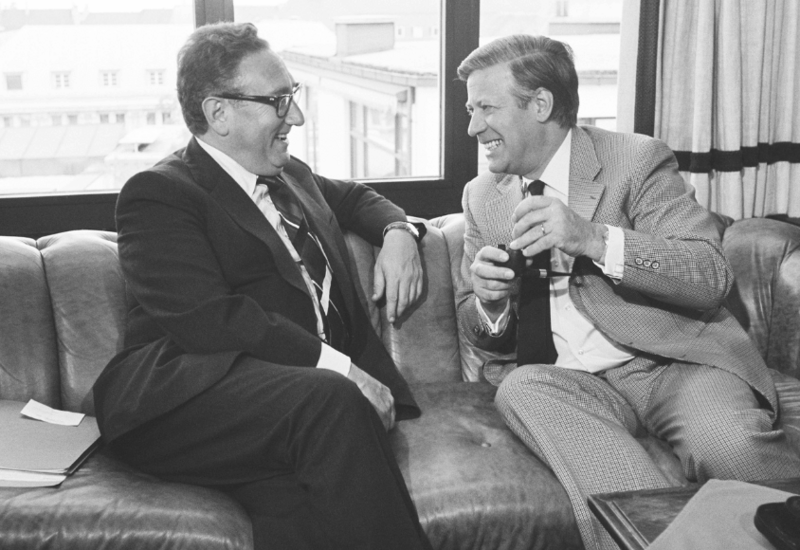
History offers a useful reference point. In the autumn of 1973, Helmut Schmidt inherited, as West Germany's Finance Minister, the simultaneous collapse of Bretton Woods and the Arab oil embargo. The old frameworks for managing energy and monetary policy were gone. No new ones existed. Schmidt's response was not to wait for clarity. He decided early that dependency was the real risk — dependency on single energy sources, on US monetary dominance, on institutions that had already shown they could fail. From that diagnosis, he acted: backing transatlantic energy cooperation at Washington in February 1974, then working with French President Valéry Giscard d'Estaing to build the European Monetary System in 1978 and co-launch the G7 summits in 1975. None of these were solutions to the crisis. They were structures built to make good decisions possible while the crisis continued. The world Schmidt was building for did not yet fully exist. He built for it anyway.
The organisations and individuals that have navigated previous interregna most successfully share that same orientation. They planned for a future the situation did not yet make visible. They built redundancy into systems that looked over-engineered in stable times. They remained open to revising their assessment instead of defending an earlier one. And they acted on their values—on what they had decided mattered regardless of conditions—instead of waiting for conditions to make the decision for them.
None of this is complicated. Demanding, yes. The work is judging what the information means.
The most likely scenario in Ukraine is a prolonged negotiating process with continued low-level conflict. A slow rebuilding of European security on different foundations, requiring sustained investment without the clarity that peace would bring.
In the Middle East, the consequences of 28 February are still accumulating. A war between the United States, Israel and Iran is a structural rupture, and its effects on energy markets, regional alliances, nuclear proliferation risk and the credibility of deterrence will take time to become legible. The assumptions underpinning stability in the region have already changed. Planning around the old assumptions is no longer adequate.
In the broader picture, the most consequential shift is the change in the relationship between the United States and its allies. European security depended for decades on a US commitment that is now conditional in ways it was not before. European rearmament is one response. It will take time, and will not fully substitute for what has changed.
The interregnum does not resolve quickly. Understanding that is the beginning of thinking clearly about what the moment requires: patience, judgment, a longer time horizon, and the willingness to build for a world whose future remains unknown.
The system that nobody had to think about now requires everyone's attention. Conditions are managed, or they are not, and which of those outcomes follows depends entirely on the quality of judgment brought to bear while the uncertainty persists.