The Currency of Control: China, Gold and the Future of Power
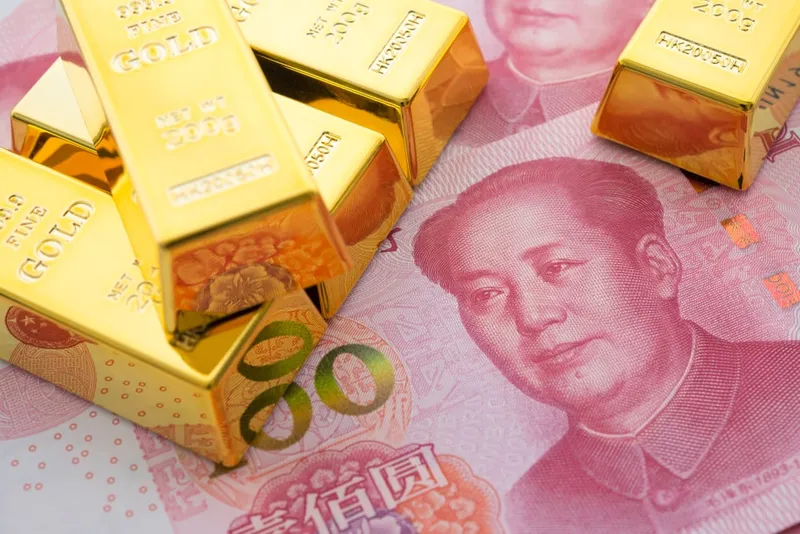
In February 2025, the People’s Bank of China (PBOC) reported an additional purchase of 73.61 million ounces of gold (at an approximate value of 208.6 billion US dollars), which was an increase from the previous month.
by
Elena Didrigkeit
Shutterstock
In fact, for the last eleven months, gold has been accumulated by Beijing as part of its financial arsenal. China appears to be synchronizing its gold purchasing with its yuan policy.
However, China’s purchase of gold really started in 2022, and now, in late 2025, it has just under 2,500 tons of gold.
With the US administration’s imposition of tariffs, the political climate between China and the US is frostier than ever before, and it is now assumed that in the longer term, Beijing is looking to diversify from the US dollar and have its own reserve-asset policy.
Beijing is not alone when it comes to purchasing gold. Other central banks have been buying gold too, to the tune of 1,000 tons a year. This sort of strategic buying highlights gold’s importance, yet China’s gold purchases seem more than simply hedging. It’s more like it’s preparing to change its current reserve strategy.
In China itself, the gold price has leaped from 630 yuan in January to 1,160 yuan more recently. Furthermore, China has relaxed its rules on banks buying foreign exchange to buy gold from overseas. This tends to indicate that gold is almost a currency hedge in China, and its internal demand for gold investment in bars and coins has jumped by around 30%.
To get an idea of the scale of China’s gold purchases, its imports via Hong Kong doubled in July (to around 44 tons).
If we hadn’t got the message, it’s now clear that we’re in the middle of a gold rally. On some metrics, during 2025, gold has gained over 50% and recently went above US$4,000 per ounce. That message is also saying we may have crypto, fintech and digital-only banks, but in gold we trust!
Although China may have aspirations for its official currency (RMB) to have a global reserve status, like the US dollar, it’s nowhere near achieving that at the moment, as it is a remote sixth in SWIFT payments and has a single-digit share of FX reserves. However, Beijing does have a long-term view of itself (look at the 2013 Belt and Road initiative that is still ongoing). Therefore, while China has plenty of digital currency infrastructure (with platforms such as mBridge and CIPS), it looks like gold as physical collateral may be returning.
Shutterstock
By increasing its gold reserves, China is also boosting the value of the yuan, as it has an unofficial peg to gold, which means that investors can rely on the yuan more than perhaps they could previously.
Where China goes, it seems that others follow, as emerging markets such as Turkey and India and BRICS+ members are reducing their exposure to the US treasury and the vagaries of the US economy, and purchasing more bullion. This has the dual effect of weakening the network effect of every country dealing in dollars and strengthening the use of other currencies for global transactions.
What Does This Mean to an Investor?
Essentially, reserve diversification is now more active because China is using gold to give it geopolitical-monetary resilience. Then you have China’s relaxation of gold import quotas, which means that the wider market will have less gold available, inevitably pushing up prices and making China’s holdings more valuable.
The gold reserves that China holds also “unofficially” support the yuan, making trade in yuan feel “psychologically” safer.
It also means that the currency power currently wielded by the mighty US dollar is shifting, gradually, very gradually, to China.
Will China’s Power Increase?
China’s power has already increased, as it was easily able to overcome the recent tariffs imposed by the US and find other trade partners who had more favorable terms. In addition, they already have control over a number of supply chains that the US needs.
Looking at gold, each ton of gold purchased by China and other central banks weakens the need to buy US Treasury bonds, reducing the US’s ability to take on debt at a highly advantageous rate. The US dollar reserve share in 1999 was 71% and is now 58% and declining.
As we have seen from China’s Belt and Road initiative, its impact has spread far and wide along and around the route that was mapped out in 2013. Certainly, China’s wealth and influence have continued to grow, so with the purchase of further gold reserves, it seems likely that power will also grow.




.jpg)