Frankly, I am growing tired of sustainability talk. Too often it feels like a ritual: people gather at an event, take photos in front of crowded logo walls, post them on LinkedIn, collect a wave of approval and go home.
by
Elena Didrigkeit
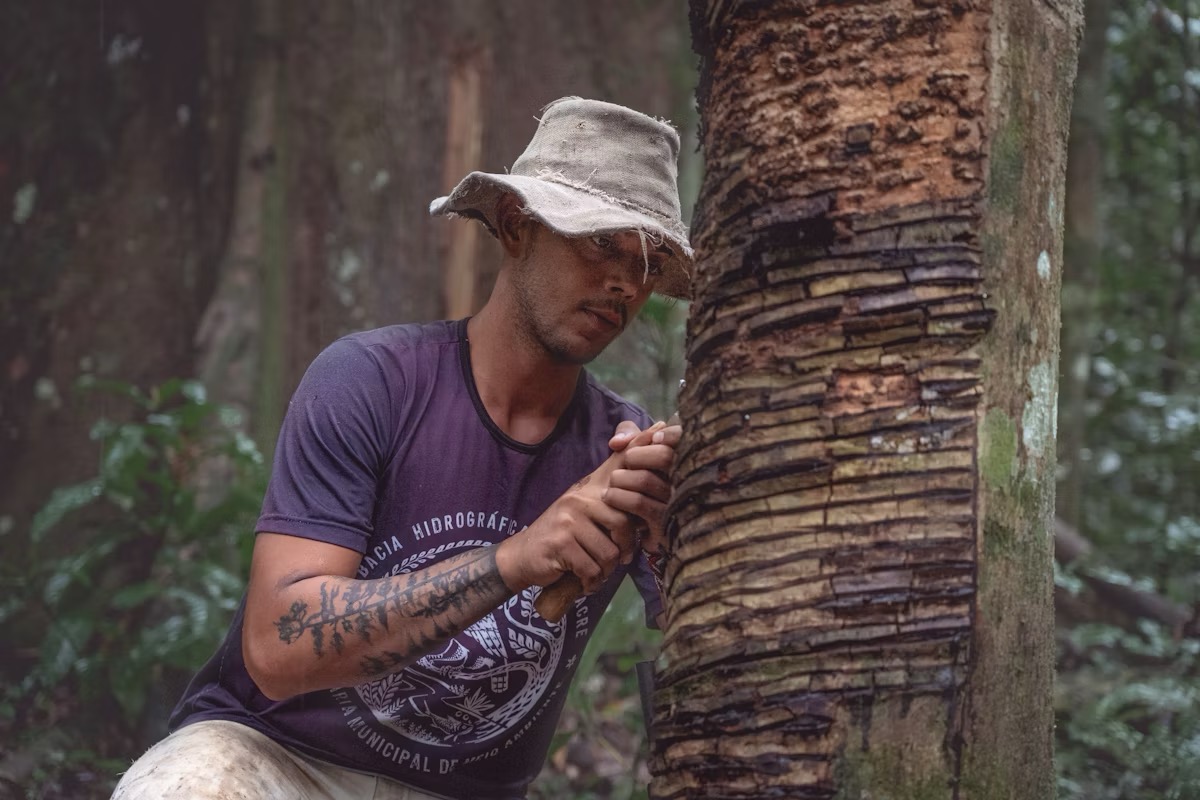
Photograph by Flávia Milhorance, “Rogério Mendes, rubber tapper in the Amazon,” in “Can Fashion Help Small Farmers Preserve the Amazon?”, The New Republic, September 7, 2021
The room empties, the language lingers and very little actually moves.
In corporate settings the word is now spoken cautiously, if at all. In fashion studios it appears on moodboards and swing tags because it is expected, a moral accessory designed to create comfort. Marketing teams, once fluent in the language of sustainability, tread carefully too, aware that every confident statement risks exposing the distance between promise and practice. Consumers are no longer entertained. They sense when something is not adding up.
Over the past year brands still reached for the word, though with a noticeable hesitation, as if afraid that speaking too clearly might invite questions they are not prepared to answer. The glossy polish that once protected sustainability has worn thin, leaving the gap between narrative and reality fully exposed.
Into this gap a different language is on its way—Regeneration. The focus shifts to how things are made rather than how they are styled: the beauty and the compromise, the harm and the attempt to repair. Regeneration invites active participation rather than applause on the side of the room and speaks to those willing to show their process as it truly is, not as a perfect story.
The Collapse of the Polished Narrative
For decades, fashion industry relied on allure—novelty, seduction, the seasonal reinvention. Yet seduction feels fragile in a world increasingly aware of consequence. Consumers now want to understand what stands behind a garment: the hands that shaped it, the fields that fed it, the water stained by its dyes.
Forward-looking houses sense the change. They know the right shade of green or the right phrasing of “planet positive” can no longer shield them from deeper responsibility. Sustainability talk once allowed brands to sound earnest while altering little. Regeneration offers no such refuge.
It is understandable that brands fear revealing the “not so beautiful” parts of production, concerned it might dismantle the romance they spent years constructing. Yet transparency has become the last remaining form of credibility. The next generation of consumers wants to see the land where fibres grow, the rooms where colours simmer in vats, the bins where scraps accumulate, the tables where repairs are made. They want to know what improves, what fails and where a brand is willing to improve.
Veja’s co-founder Sébastien Kopp captured this cultural fatigue with rare bluntness on stage at the Global Fashion Summit in Copenhagen. “I used to say sustainability was a bag of vomit,” he said, “because it doesn’t mean anything, and maybe there are too many things in the bag.” It was not provocation for its own sake, but an admission that the word had become a container too overloaded to carry truth.
The Raw Campaigns We Are Waiting For
Imagine a campaign that abandons whitewashing entirely. No art-directed studios, no softened edges. Instead: a workshop in unfiltered light. Such honesty offers a rare kind of moral clarity, the kind that immediately feels like fresh air. This approach creates space for trust and allows the consumer to move toward or away from a brand on their own terms. It opens room for critique and affection, for doubt and return. The viewer is treated as a thinking human being rather than a reaction to be engineered. True authenticity emerges only when the story is shown without filters, raw and real.
I want to see more of that—and many people do. We do not need protection from complexity; we simply want to know where we stand. Most of us long for a place we can return to, a maker steady enough to accompany us over years. Because a truly sustainable wardrobe is built on pieces that stay and mature with us.
Veja’s co-founder remarked in a Vogue interview that the most sustainable choice is simply to wear your shoes longer. Longevity turns an object into a companion. Sustainability talk was never able to convey this truth because it always orbited the brand. Regeneration orbits the relationship.
A More Human, More Demanding Future
Regeneration is the more demanding path. It requires patience, curiosity and the willingness to face an imperfect process without disguise. It also asks for a kind of cultural adulthood—a readiness from brands to be seen as they truly are, to show progress as well as missteps, and to trust that consumers recognise sincerity. We are no longer persuaded by narratives that ask us to imagine change.
What we want now is simple:
- Show us how you make what you sell. - Show us what breaks. - Show us what you are striving to make better.
This is the only luxury that still carries meaning.